If you are eyeing an equestrian property in Wellington, you already know the stakes. The right setup can support a winning season and a comfortable day-to-day routine, while the wrong one can drive up costs and add friction to every ride. You want clear guidance that translates the Wellington market into a practical, high-level checklist you can use on every tour.
This guide focuses on what matters most in Wellington: location, regulations, infrastructure, and the features that separate a casual horse property from a serious equestrian estate. You will learn how to evaluate barns, arenas, turnout, services, and long-term operating needs so you can buy with confidence.
Let’s dive in.
Why Wellington matters
Wellington is a premier equestrian hub. The main showgrounds at Wellington International host the Winter Equestrian Festival and Global Dressage Festival, and the area is also home to a top-tier polo facility at the International Polo Club. These venues create strong seasonal demand for quality stabling and housing that drives the local market for high-function equestrian estates. You can see the scale of activity by reviewing the venues and leadership at the Wellington International showgrounds and the International Polo Club area.
Proximity is practical. The showgrounds are commonly described as about a 20-minute drive from Palm Beach International Airport, which is a real advantage when you travel frequently with horses and staff.
Support services are close at hand. Wellington concentrates specialist vets, equine hospitals, farriers, feed and tack suppliers, and permitted waste haulers. Palm Beach Equine Clinic operates a major hospital campus in the area, giving you convenient access to advanced care and 24/7 support. Review their contact details and emergency resources through the Palm Beach Equine Clinic.
Rules and permits first
Before you fall in love with a barn or ring, confirm that the property can legally function the way you intend.
Equestrian Overlay Zoning District (EOZD)
The Village of Wellington has an Equestrian Overlay Zoning District with specific rules for stables, arenas, groom’s quarters, and related uses. Standards vary by subarea, including setbacks and covered-arena rules. Always verify whether the parcel lies in the EOZD and which subarea applies. Review the EOZD code and permitted uses.
Practical tip: Do not assume you can expand or roof an existing arena without approvals. Covered arenas and large roof systems typically require engineered review and permits.
Building permits and approvals
Barns, covered arenas, pole barns, and accessory structures generally require building permits. Electrical, water, and septic work are reviewed separately. Confirm whether existing improvements were built with permits and passed final inspections. Start with the county’s published categories for permit types covering barns, arenas, and accessory structures.
Agricultural classification and taxes
Palm Beach County offers agricultural appraisal for bona fide agricultural use, which can reduce property taxes. Equestrian uses are included, but the county evaluates factors like horses per acre and expected records. If you plan to maintain an agricultural classification, confirm the current status and documentation requirements with the Palm Beach County Property Appraiser’s agricultural guidance.
Manure and environmental rules
Wellington and Palm Beach County require Best Management Practices for equestrian waste. Livestock waste haulers must be registered, and approved disposal or composting is required. Large operations must be ready to show a compliant plan. You can review county planning materials on equestrian waste and BMPs and UF/IFAS guidance on composting and managed storage.
Floodplain and drainage
Flood zones and drainage infrastructure are significant in Wellington. Arena siting, septic, and any covered structures can be affected by floodplain regulations and South Florida Water Management District rules. Request a flood-zone determination letter from the Village early in due diligence.
CC&Rs and business use
Many subdivisions and gated equestrian communities have covenants that control fencing, barn appearance, arena lighting, stall counts, and commercial activities. These private rules can be stricter than municipal code. Always request recorded CC&Rs and HOA guidelines.
What to look for on tour
Use this section as a functional checklist. The goal is to separate a leisure-friendly property from a competition-ready estate.
Barn and stable essentials
For adult sport horses, 12×12 ft stalls are a common baseline. Larger horses, stallions, or foaling stalls often run 12×14 to 14×14. Verify current stall dimensions and whether expansion is feasible. A survey of boarding operations highlights 12×12 as the most typical stall size in boarding barns. Review the study on stall norms in boarding barn facilities.
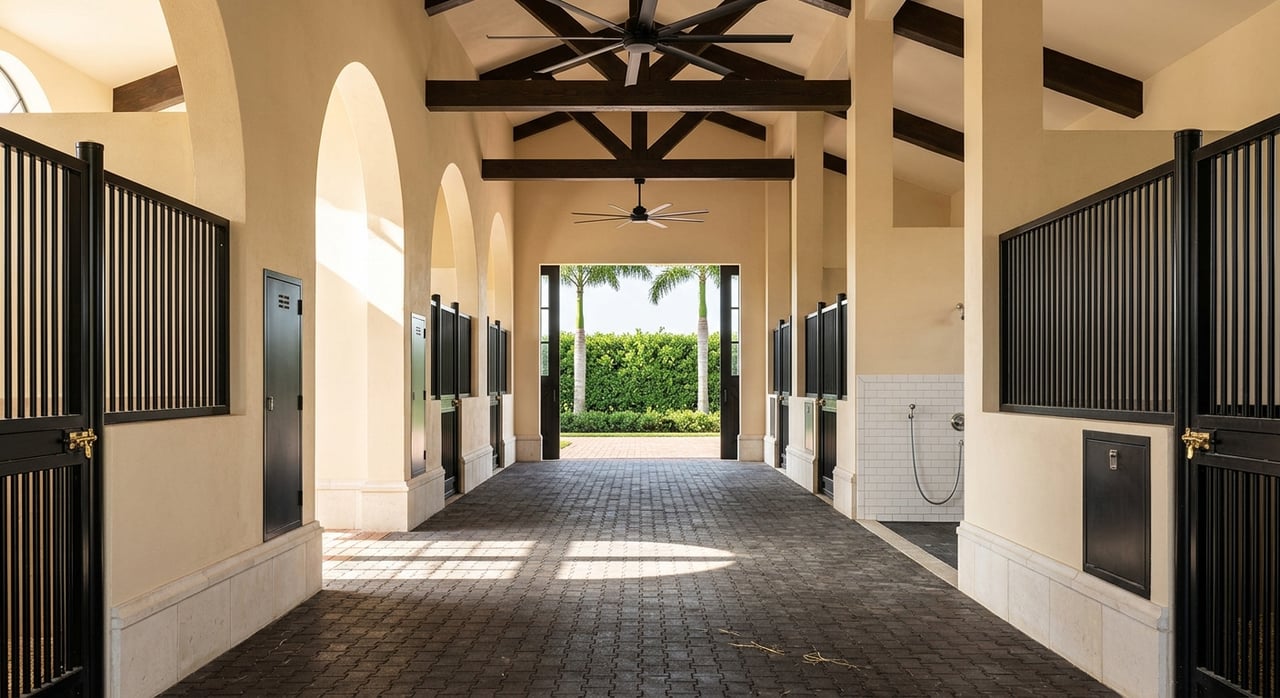
Look for a wide central aisle, ideally 10–12 ft or more, for safe horse and equipment movement. Confirm a slip-resistant wash stall with hot and cold water, a dedicated feed room, and a lockable tack room. Check hay storage capacity for multi-week supply, mechanical ventilation, ceiling height, electrical outlets, and waterproof lighting.
If staff housing is important, evaluate groom’s quarters, laundry, and office space. For any commercial boarding or training plans, ask whether the barn’s water and septic can support public restrooms or higher occupancy, and confirm the permit history for those fixtures.
Quick checks:
- Measure stall sizes and aisle width, and check for stall matting.
- Confirm hot water in wash areas and capacity for multiple hoses.
- Estimate cubic storage for feed and tack, plus hay delivery access.
- Note fire access routes, egress doors, and any generator hookups.
Arena size, footing, and drainage
Discipline drives ring dimensions. Standard dressage competition uses a 20×60 m arena, while a 20×40 m arena suits certain levels or training spaces. Jumpers need larger arenas with safe approaches and landing distances. Validate dimensions against your program needs and review the standard competition arena sizes.
Footing and drainage are critical. Ask for documentation on how the ring was built: sub-base, base, geotextile, sand or sand-fiber blends, crown, under-drain, and irrigation. A ring without proper drainage can be costly to maintain and difficult to use during the wet season. If the arena is covered or roofed, expect structural permitting and Florida wind-load compliance under Wellington’s standards outlined in the EOZD regulations for covered arenas.
Also confirm:
- Safe truck and trailer approach and warm-up areas.
- Lighting quality and whether fixtures were permitted.
- Stormwater flows away from barns and paddocks.
Turnout, paddocks, and fencing
Serious programs favor multiple paddocks for rotation, loafing pads in heavy-use areas, and clear equipment gates. Industry practice often uses visible, impact-resistant fences, and adult-horse fencing typically ranges around 4½ to 5 ft in height, with specific choices driven by your horses and discipline. Pair turnout plans with manure and pasture management that follows BMPs, including setbacks from water and documented composting or hauling. See UF/IFAS guidance on manure and pasture management practices.
Site infrastructure and logistics
Determine if the property is on municipal water and sewer or on well and septic. Many barns run on septic, and bathrooms, laundry, and wash racks can push capacity. Request septic permits, inspection reports, and a drainfield map. Review the county’s permit categories for items such as septic, driveways, and parking in the Palm Beach County permit types guide.
Ask about power service size and whether wiring is to code. Larger barns often use 200-amp service or more and may have standby generators for pumps and lighting.
Finally, walk the access route for rigs. Confirm driveway width, turning radius, overnight trailer policies in any HOA, and safe staging areas if you plan to host clinics or haul-ins.
Distance to venues and services
If you plan to show frequently, measure the drive to Wellington International and the International Polo Club. Shorter hauls reduce stress for horses and make it easier to sync with vets and farriers. You can reference venue details from Wellington International and IPC when planning routes.
Due diligence checklist
Use this summary to organize pre-contract steps and your first site visit.
Legal and zoning
- Verify parcel zoning, EOZD subarea, and permitted uses. Request written land-use verification from the Village.
- Pull CC&Rs and HOA rules for stall counts, arena lighting, fence design, and any limits on instruction or boarding.
- Request permit history and copies of building, electrical, and septic permits plus any elevation certificates. Start with the county’s permit type index.
Site and infrastructure
- Measure stall sizes and aisle width. Confirm hot water and wash-stall safety.
- Ask for written arena construction notes specifying base, footing, and drainage. Confirm stormwater flows away from structures.
- Inspect fencing height and visibility. Note replacement needs.
- Identify manure storage or composting areas. Ask for recent hauling receipts or the hauler’s registration.
- Confirm well logs or municipal water letters, and septic inspection and drainfield maps.
- Test trailer access and staging areas during your tour.
Services and operations
- Confirm vet and farrier availability and emergency response times. Palm Beach Equine Clinic is a major local resource.
- Discuss insurance and financing, especially if you plan to board or train. Barn configuration can affect liability coverage.
Long-term use, costs, and risk
Top operating costs include bedding and forage, manure hauling or composting, arena footing maintenance, staff wages, utilities for wash and irrigation, insurance, and property taxes. If you intend to pursue an agricultural classification, review the documentation standards described by the Palm Beach County Property Appraiser.
Plan for storms and floods. Request elevation certificates, confirm roof and wind-load standards for any covered structures, and invest in reliable generators and elevated hay storage. A written evacuation and hauling plan protects horses and staff. Wellington provides useful resources through its floodplain management and map portal and offers a flood-zone determination service you can use during due diligence.
Be a good neighbor and steward. Documented manure management, vegetative buffers, and pasture rotation reduce environmental risk and help avoid nuisance complaints. County planners have summarized expectations and options in their equestrian waste guidance.
First-visit quick card
- EOZD subarea and permitted uses confirmed in writing.
- Permit history in hand for barns, arenas, electrical, and septic.
- Stall count and sizes measured. Aisle width measured.
- Arena dimensions and footing/drainage construction documented.
- Manure storage location identified and hauling receipts reviewed.
- Well and septic documentation requested. Irrigation capacity noted.
- Drive times to Wellington International, IPC, and your chosen clinic confirmed.
Work with a trusted local advisor
The right advisor helps you streamline due diligence, verify the details, and secure the property that fits your program. Our team pairs deep local knowledge with discreet, white-glove coordination, from pre-offer intelligence to introductions to vetted inspectors and service providers. If you are exploring Wellington equestrian properties, we would be honored to assist.
Request a private consultation with The Jack Elkins Team to discuss your goals and timeline.
FAQs
What is Wellington’s EOZD and why does it matter?
- The Equestrian Overlay Zoning District sets specific rules for stables, arenas, groom’s quarters, and related uses. Standards vary by subarea, so confirm your parcel’s subarea and permitted uses in the EOZD code.
How close should I be to the showgrounds for daily competition?
- Shorter drives reduce stress for horses and staff. The showgrounds are commonly cited as about 20 minutes from PBI, and you can plan routes using details from Wellington International.
What stall size works best for adult sport horses?
- A 12×12 ft stall is a common baseline in boarding barns, with larger 12×14 to 14×14 ft stalls for bigger horses or foaling. See the study on stall norms in boarding facilities.
Do I need a manure removal or composting plan in Wellington?
- Yes. The Village and County expect Best Management Practices and registered haulers or compliant composting. Review planning guidance on equestrian waste BMPs and UF/IFAS resources on composting and storage.
Can I qualify for agricultural tax classification with horses?
- Equestrian uses can qualify if they meet county standards for bona fide agricultural activity. Confirm recordkeeping and use requirements through the Palm Beach County Property Appraiser.
What permits are needed to build or roof an arena?
- Expect building permits and engineered review for roofed or covered arenas, plus separate approvals for electrical and water. Start with the county’s permit types guide and confirm EOZD standards in the Village code.