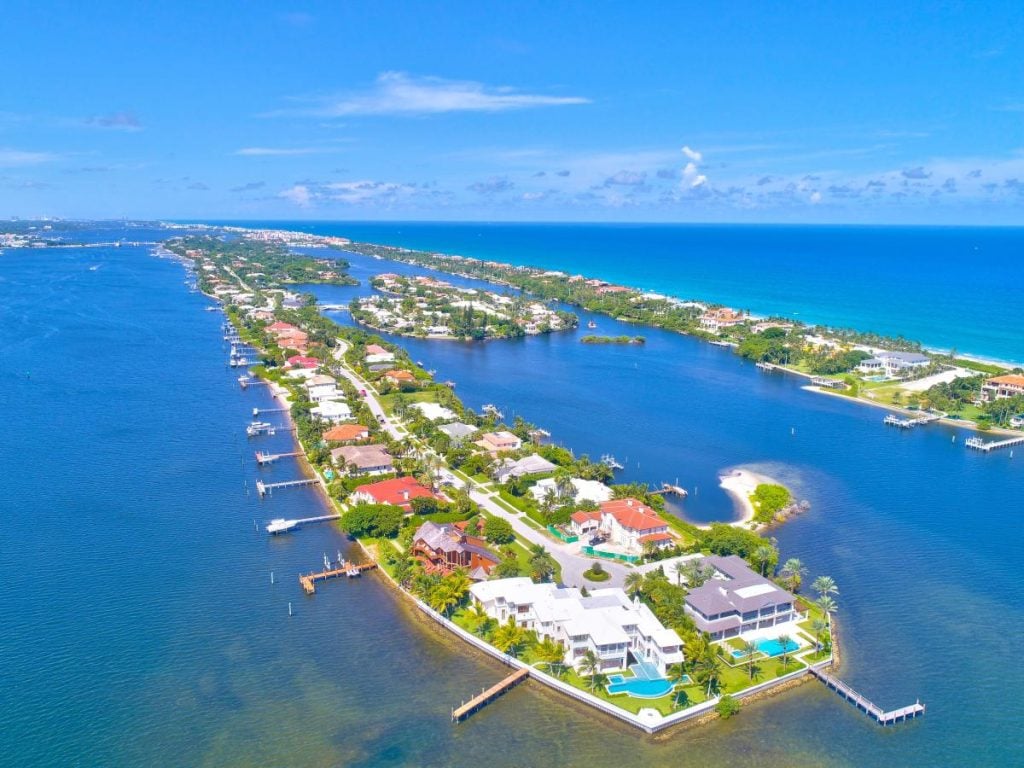
A buyer looking at a dated one-story on Polo Drive or a canal-front lot in Place au Soleil usually does the math the same way. Purchase price, plus a renovation budget, plus a construction timeline pulled from a builder's estimate. Ninety days to close, eighteen months to finish. The permit is treated as paperwork, a formality that happens somewhere in the gap between signing with a contractor and pouring a foundation.
In the Town of Gulf Stream, that assumption costs people months. According to the Town of Gulf Stream's approvals page, the building permit is not the first gate. It is the last one, issued only after a separate design review process runs its own course on its own calendar, one that meets once a month, skips August entirely under the Gulf Stream Code.
The Permit Comes Second, Not First
Gulf Stream doesn't run its own building department. According to the Town of Gulf Stream's permits page, permits are processed through an interlocal agreement with the Town of Highland Beach, entirely through a digital portal, with no paper applications accepted. That part is administrative and, by South Florida standards, fairly ordinary.
What is not ordinary is the sequencing. Gulf Stream's own zoning requirements and design approvals have to be satisfied first, before Highland Beach will issue anything. The town's Architectural Review and Planning Board, known locally as the ARPB, has to sign off on the design before the permit application even becomes eligible for review. A contractor can have engineering drawings ready and financing lined up, and none of it moves the permit clock until the design has cleared a separate municipal board that meets on its own schedule, in its own room, on its own terms.
For a buyer used to permit offices that process applications on a rolling basis, this is the first surprise. The second is how granular that design review actually is.
What Actually Triggers Each Level of Review
Gulf Stream splits design review into three tiers, and which one applies depends on the scope of the work, not just its cost.
| Level | Who decides | What triggers it |
|---|---|---|
| Level 1 | Town planning and building staff | Accessory structures and minor renovations affecting under 300 square feet |
| Level 2 | The ARPB | Expansions or demolitions over 300 square feet but under half the existing floor area, use of a discouraged architectural style or material, or removal of more than two trees over eight inches in caliper |
| Level 3 | The Town Commission, after an ARPB recommendation | Zoning map amendments or projects under a development agreement |
A kitchen remodel that stays inside the existing footprint might clear Level 1 with staff sign-off.
Most renovation-minded buyers in Gulf Stream are living in Level 2 territory, which is where the calendar starts to matter.
The Monthly Clock and the Month That Doesn't Exist
The ARPB is five members and two alternates, appointed by the Town Commission, meeting on the fourth Thursday of each month except August at 8:30 a.m. at Town Hall on Sea Road. Before an application can even be filed, the applicant has to sit through a mandatory pre-application conference with town staff at least fifteen days ahead of submission. Once filed, the application has to land at least fifteen days, and no more than sixty, before the hearing date.
Run that sequence in a normal month and the minimum runway from "we've decided to add a second story" to "we're standing in front of the board" is somewhere around six to eight weeks, assuming the timing lines up cleanly with the next scheduled meeting and nothing gets bumped.
Then there's August. The ARPB does not meet in August at all. Any deadline in the code that would otherwise fall in that month is automatically extended by thirty days. A project that would have been filed in late July for an August hearing simply loses the entire month.
And that's the best case. If the board asks for revisions rather than approving outright, which local builders describe as a real possibility on more complex projects, the applicant doesn't get a follow-up call two weeks later. The next opportunity is the following month's fourth Thursday. Two revision cycles can add two full months on top of the baseline.
Only after the ARPB approves does a project become eligible to enter the Highland Beach permit portal, where standard plan review and inspection scheduling begin. Only after that does the construction clock start, and local Gulf Stream builders put that clock at fifteen to twenty-four months for estate-grade work, with costs running from roughly seven hundred to over twelve hundred dollars per square foot depending on waterfront exposure and material specification.
Add it up and a buyer who assumed a year and a half from closing to move-in could easily be looking at closer to two years once design review, potential revision cycles, and the August gap are priced in.
When the Rulebook Changed Mid-Project
The Coastal Star reported on a change to Gulf Stream's rules in the Core District, the stretch of homes on the east side of Polo Drive and the west side of Gulfstream Road.
An ad hoc committee, chaired by Paul Lyons and including ARPB chair Malcolm Murphy along with Gary Cantor, Michael Glennon, Bill Koch III, and Thom Smith, spent months studying complaints about oversized new construction overwhelming its neighbors. On December 13, 2024, the Town Commission declared what's known as a zoning in progress, a formal freeze that stopped new building permits in the Core District while the town rewrote its own massing rules.
The changes that emerged were specific. One-story homes in the overlay got a floor area ratio bump from 33 percent to 36 percent, roughly a 10 percent gain in buildable square footage, explicitly to make single-story construction more attractive. Two-story homes got the opposite treatment: the allowable second-floor area was cut from 50 percent of the first floor down to 30 percent, and maximum roof height dropped from 30 feet to 28 feet. Mayor Scott Morgan described the changes as a fair way to steer the town back toward the lower, more understated profile that had historically defined the Core.
For anyone under contract or shopping in that stretch during the freeze, the buildable envelope on a lot changed while the deal was still in motion. Murphy's own departure as ARPB chair, stepping down that same December as he returned to South Africa, landed in the same window, meaning the board itself was mid-transition at the exact moment it was implementing new rules. Nearly two years later, the overlay's FAR and height limits are simply how the Core District works now, but the episode is a reminder that the rulebook here is not static. None of this shows up in a listing description. It shows up when a buyer's architect goes to pull the numbers and finds the math has moved.
What the Design Manual Actually Controls
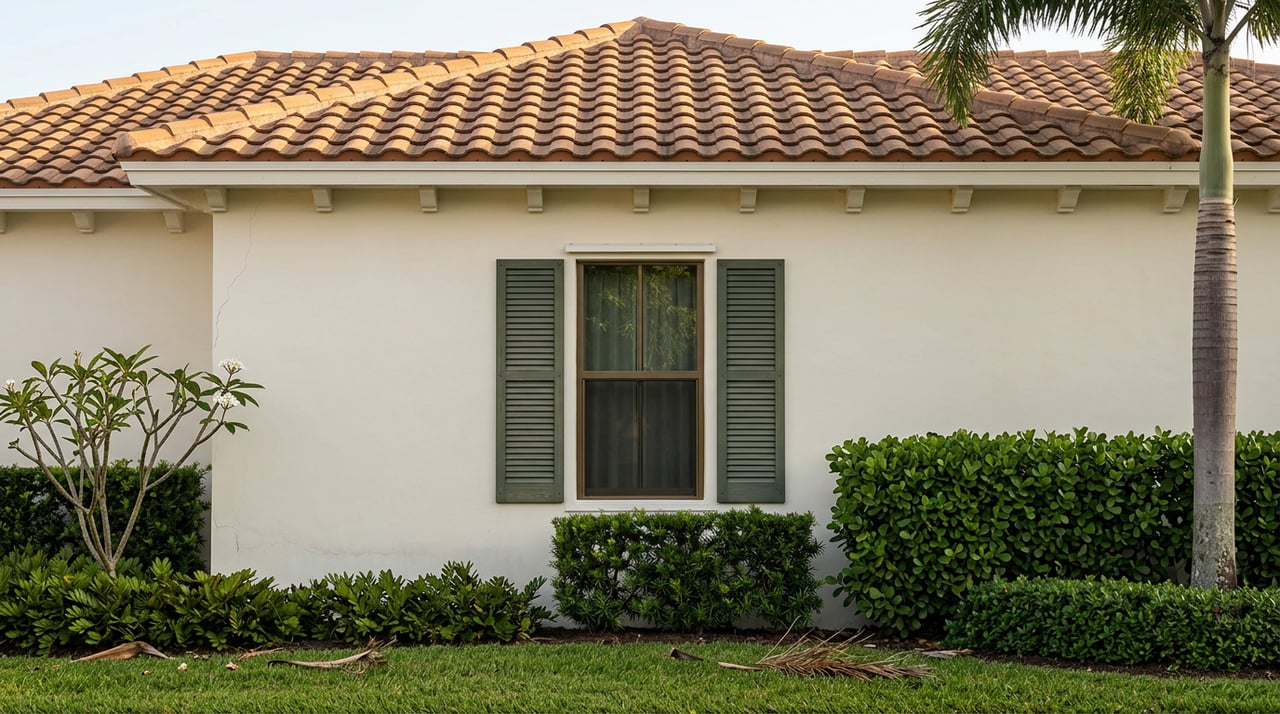
Even outside a rule change, Gulf Stream's design manual goes well past typical zoning in what it dictates. The Town of Gulf Stream's design manual says roof materials have to match the architectural style: white cement tile for Gulf Stream Bermuda homes, barrel tile with approved color blends for Spanish Mediterranean Revival. Flat roofs are capped at 25 percent of total roof area unless used specifically to reduce visual massing, and most metal roofing is prohibited outright except as a minor decorative accent. Shutter colors are limited to a defined palette of whites, blacks, deep greens, taupe, and similar tones, and hurricane shutters have to closely match.
This level of specificity is exactly why the ARPB exists as a separate gate from the permit office. A building permit checks structural code compliance. It has no mechanism to evaluate whether a proposed roof tile is authentic to the architectural style of the house next to it. That judgment call sits entirely with the board, on its monthly schedule, which is the whole reason the sequencing matters as much as it does.
Why the Trophy Tier Sits Longer on Market
Here's where the design review timeline shows up in the market data itself. In the second quarter of 2026, Gulf Stream's five-million-dollar-and-above tier posted a median sale price of $9.6 million with a median of 144 days from original listing to closing. That's measurably slower than the roughly 113-day median days on market reported across all Gulf Stream price points in August 2026.
The two figures come from different windows and different scopes, so they shouldn't be read as a precise apples to apples comparison. But the direction is worth sitting with. The trophy tier, where generational estates and renovation-candidate lots concentrate, closes more slowly than the market as a whole. Given everything above, a chunk of that gap is plausibly not buyer hesitation at all. It's the design review clock running in the background of deals that involve rebuild or major renovation plans, quietly extending the distance between an accepted offer and a closed sale.
Before You Write a Renovation Contingency
- Ask whether the property has any prior ARPB history. A house with an approved but unbuilt renovation plan can save an entire review cycle.
- Confirm which side of the Core District boundary a lot sits on before assuming a floor area ratio. The rules changed once already and apply unevenly across the town.
- Never assume August exists on the ARPB calendar. Build renovation contingencies around a board that effectively takes the month off.
- Treat the pre-application conference as the actual start of your timeline, not the closing date.
A Few Questions Worth Asking Directly
Does an already-approved design carry over to a new owner? It's worth confirming the specific approval's terms with the town before relying on it.
Do landscaping changes really require this level of review? Yes in some cases. Removing more than two trees over eight inches in caliper is enough on its own to trigger a Level 2 review, independent of any structural work.
Is the Core District overlay permanent? It reflects a deliberate commitment by the current commission to the town's historically lower-profile aesthetic.
Understanding a calendar like this from the outside is hard. It's much easier with someone who has sat through the pre-application conferences and knows which projects glide through Level 2 in one hearing and which ones don't. If you're weighing a Gulf Stream property with renovation or rebuild plans attached, The Jack Elkins Team can walk the timeline with you before you write the offer, not after. Request a private consultation to talk through what a specific lot, and its place on the design review calendar, actually means for your move-in date.
This article is general information, not legal, tax or financial advice. Consult a qualified professional about your situation.