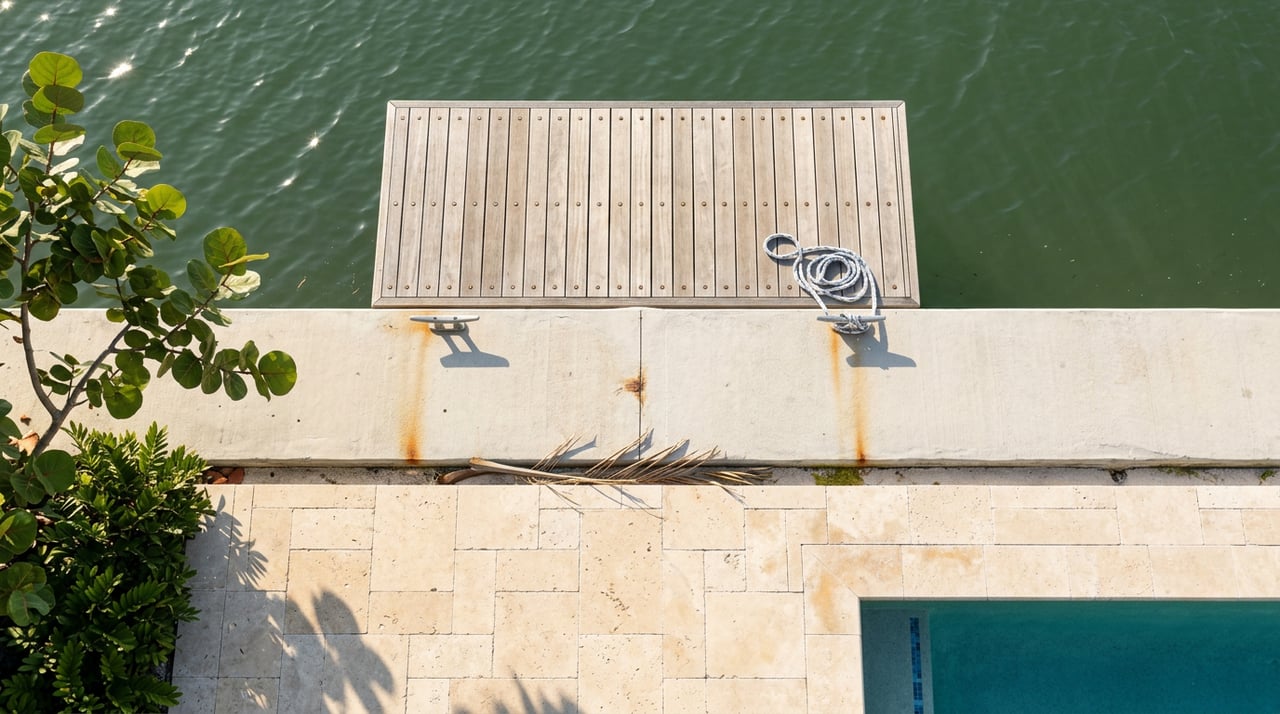
Say you own a dock on the northern tip of Hypoluxo Island, along North Atlantic Drive. Your mailing address says Lantana. Your property tax bill says Lantana. For as long as you've owned the place, you assumed that if you ever needed to repair a piling, replace a lift, or extend a finger pier, you'd call Lantana's building department, same as every other waterfront owner on the island.
As of this summer, that assumption is wrong for you and fourteen of your neighbors.
The Line That Moved in June
On June 22, 2026, the Lantana Town Council unanimously approved an agreement with the Town of Palm Beach after updated mapping showed something nobody had flagged before: the docks belonging to 15 waterfront properties at the northern end of Hypoluxo Island sit not in Lantana's jurisdictional waters, but in Palm Beach's. The two municipalities had to work out, in a formal interlocal agreement, who actually has the authority to approve a boat dock, pier, piling, boat lift, or floating dock for those specific addresses.
The fix Lantana negotiated is not "you now deal with Palm Beach." It's more particular than that. Lantana asked for, and received, delegated authority to administer, process, review, and approve dock permits for those 15 properties, using its own code of ordinances even though the underlying water belongs to Palm Beach. In practice, that means a dock owner on that stretch of North Atlantic Drive is dealing with Lantana staff, but the permit sits on top of a jurisdictional boundary that was misunderstood for years.
If you own or are buying a dock on the northern tip of Hypoluxo Island, the town that regulates your seawall and the town listed on your deed are not automatically the same town. Confirm this before you sign anything, not after.
Why the Line Was Wrong in the First Place
Municipal boundaries on barrier islands rarely follow property lines the way they do on the mainland. They follow water. Lake Worth Lagoon has been remapped and re-surveyed more than once as GIS tools improved, and small errors in where a jurisdictional line falls in open water tend to sit undiscovered for decades because nobody has a reason to check until a permit application forces the question. That's what happened here. A routine mapping update surfaced a boundary problem that had presumably existed since the lots were platted, and Lantana's staff had to go ask a neighboring town for authority it didn't previously have any reason to think it lacked.
This is worth sitting with if you're evaluating a purchase on this island. The boundary between two towns' water is not always self-evident from a plat map or a listing sheet, and the people most likely to discover a jurisdictional gap are municipal staff processing a permit application, not a buyer's title search.
The Dispute Isn't Settled
The June agreement was supposed to close the question. It hasn't. Coverage from The Coastal Star, the monthly paper that covers this stretch of coast from South Palm Beach through Hypoluxo Island, Manalapan, and down to Delray Beach, reported in early September 2026 that Lantana and South Palm Beach are now in an active dispute over who controls Intracoastal dock permitting in this same area. The specifics of that fight are still developing, but the headline fact for anyone transacting here is simple: as of mid-September 2026, the question of which municipality has final say over dock permitting on parts of Hypoluxo Island is not fully resolved.
For a buyer under contract or a seller planning dock repairs before listing, an open jurisdictional dispute is not background noise. It's the kind of thing that can add weeks to a permit review, or worse, put a pending application in limbo while two towns work out who signs off on it.
What This Actually Changes If You're Buying or Selling
None of this affects who owns the submerged land, and it doesn't touch riparian rights, which come from Florida law regardless of which town administers the paperwork. What it changes is the permitting path. Here's what that means in practice for the 15 addresses affected and, more broadly, for anyone treating a Hypoluxo Island dock as a simple line item in a purchase or listing.
- Confirm jurisdiction before you assume it. Don't rely on the town listed on the tax roll to tell you who regulates the water in front of the house. Ask directly, in writing, which municipality's code governs any dock, seawall, or lift work at that specific address.
- Pull the permit history, not just the survey. A dock that was permitted years ago under one town's code may need a fresh look if any modification is planned now, especially while the interlocal arrangement is still being tested.
- Build permitting uncertainty into your timeline. If a seller is promising a completed dock repair before closing, or a buyer is planning lift work right after closing, factor in that permit review on this stretch of the island currently touches two municipal governments instead of one.
- Remember this sits on top of the existing stack, not instead of it. Palm Beach County's Environmental Resources Management division, the Florida Department of Environmental Protection, and the U.S. Army Corps of Engineers still have their own separate review requirements for any dock work in the Lake Worth Lagoon. A municipal permitting answer doesn't remove the need for the county, state, and federal layers we've walked through before in our own guide to dock and boat lift basics on Hypoluxo Island.
- Loop in your title company early. This is the kind of detail worth raising with title and closing counsel well before the inspection period ends, not during it.
The Comps Problem Sitting Underneath the Permits
The permitting story is really one piece of a broader pattern on this island: assumptions that hold everywhere else in Palm Beach County don't reliably hold here, because the market is so thin that a handful of closings can swing the numbers dramatically.
As of March 2026, the median sale price on Hypoluxo Island stood at $3.3 million, up 43.2 percent from the same month a year earlier. The average price came in at $6.1 million, up 74.3 percent year over year. Days on market fell from a median of 362 days the prior year to 178 days in the same period this year. All of that movement came from just four closed sales that month, down from five the year before.
Numbers that volatile aren't describing a market trend so much as describing what happens when a market has almost no transaction volume to smooth out. One $9 million closing and one $2 million closing in the same month will produce a median that looks nothing like either property. Some listing aggregators still describe the island's typical home price in the mid $600,000s, a figure that has nothing to do with what's closing on Hypoluxo Island now and appears to reflect stale or mismatched data rather than the current waterfront tier. A separate midyear brokerage review of Lantana's broader $1 million-plus single-family tier found a median sale price of $2.55 million through mid-July 2026, on just four closed transactions totaling $9.6 million, which points the same direction: this is a market where the sample size, not the trend line, is the thing to interpret carefully.
The lesson runs parallel to the permitting story. On an island this small, both the price you'll actually pay and the process you'll actually go through depend on specifics that a generic search result won't surface. That's true of a dock permit tied to a jurisdictional line nobody had mapped correctly until this year, and it's true of a median price built on four sales instead of forty.
A Few Questions Worth Asking Directly
Does this affect every dock on Hypoluxo Island, or just some? Only the 15 properties along North Atlantic Drive at the island's northern end are affected by the June 2026 jurisdictional agreement. The rest of the island's docks remain under Lantana's standard permitting process.
If my dock already has a valid permit, do I need to do anything? An existing, validly issued permit doesn't need to be reopened on its own. The jurisdictional question becomes relevant when you apply for new work, a repair, a replacement, or when a sale prompts a buyer's lender or insurer to ask for permit documentation.
Does this change who owns the water in front of my property? No. Riparian rights and submerged land ownership are governed by Florida law and are separate from which municipality administers construction permits. This is a permitting authority question, not an ownership question.
Hypoluxo Island rewards buyers and sellers who ask specific questions before they need the answers, whether the question is about a seawall's condition, a dock's depth at mean low water, or, as of this year, which town's staff will actually be reviewing your permit application. If you're weighing a purchase or a sale on this stretch of the Intracoastal and want someone who tracks these details before they become closing problems, the Jack Elkins Team is glad to talk through what a specific address on Hypoluxo Island actually requires. Request a private consultation and we'll walk through it together.